




Kraft paper bags have been around for over a century, yet their relevance has only grown stronger as businesses and consumers alike shift away from single-use plastics. Walk into any grocery store, bakery, or farmer's market today, and you'll see them everywhere—brown, sturdy, and unmistakably practical.
But what exactly are grocery kraft paper bags? And what makes them such a reliable choice for food packaging? This post breaks down everything you need to know: from the basics of kraft paper construction to its role in modern food packaging and its credentials as an eco-friendly material.
What Kraft Paper Bags Actually Are
Kraft paper gets its name from the German word for "strength"—and the name is well earned. The material is produced through the kraft process, a chemical pulping method that converts wood chips into pulp by removing lignin and other impurities. The result is a paper fiber that is notably stronger and more tear-resistant than standard paper.
Grocery kraft paper bags are typically made from either virgin kraft pulp or recycled kraft fiber. Virgin kraft tends to be stronger and more uniform in appearance, while recycled kraft is a more resource-efficient option that still delivers solid performance for most packaging applications.
These bags come in a range of formats:
Flat bottom bags — ideal for bulkier grocery items
Side-gusset bags — commonly used for dry foods like flour, sugar, or grains
Stand-up pouches with kraft exteriors — a hybrid style that blends structure with shelf appeal
Multi-wall kraft bags — used for heavier products that require additional layering
The thickness of the paper (measured in grams per square meter, or GSM) determines how much weight a bag can safely carry. Most grocery kraft paper bags fall between 70 GSM and 120 GSM depending on their intended use.
How Kraft Paper Bags Are Used in Food Packaging
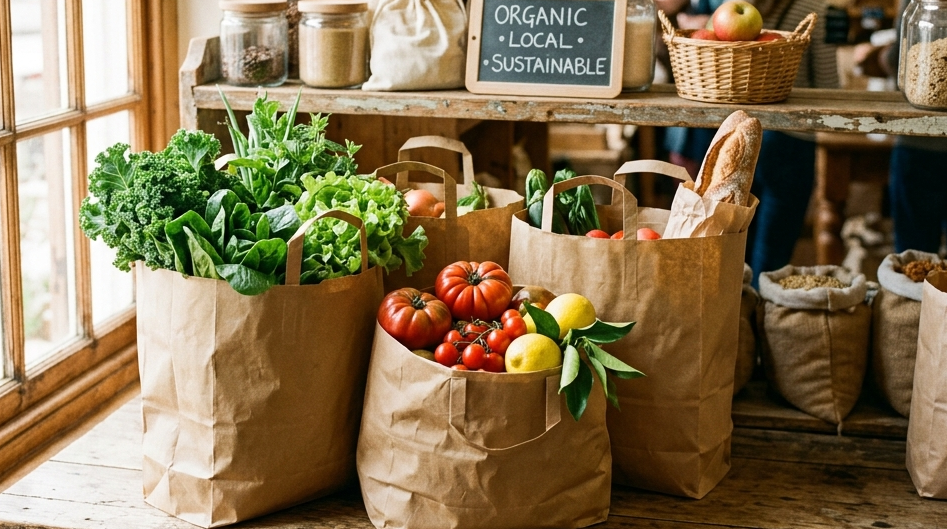
Kraft paper bags have carved out a broad role across food retail and food service. Their natural texture and neutral brown color give products a clean, artisanal look—something that resonates strongly with today's shoppers who value transparency and authenticity in the brands they buy from.
Below is a comparison of common food bags packaging applications and how kraft paper bags perform across key criteria:
Application | Bag Type | Key Requirement | Kraft Paper Suitability |
|---|---|---|---|
Bread & Baked Goods | Flat or side-gusset | Breathability | ✅ High |
Coffee & Tea | Stand-up pouch | Barrier properties | ✅ With foil lining |
Dry Groceries (flour, rice) | Multi-wall kraft | Load strength | ✅ High |
Fresh Produce | Perforated kraft | Ventilation | ✅ Moderate |
Fast Food & Takeaway | Flat kraft bag | Heat resistance | ✅ Moderate |
Snacks & Nuts | Gusseted kraft pouch | Seal integrity | ✅ With lamination |
For applications that require moisture barriers or grease resistance—such as oily snacks or refrigerated items—kraft paper bags are often laminated with a thin layer of PE film or aluminum foil. This gives the bag added functionality while preserving the kraft paper's natural appearance on the outside.
Maixin Packaging, a food packaging manufacturer based in Zhongshan, China, produces a range of customizable kraft paper bags designed specifically for food use. Their catalog includes moisture-proof options and stand-up pouches with spouts, catering to a wide variety of food products. You can explore their kraft paper bag range at www.maixinpackingtech.com.
Why Eco-Friendly Kraft Bags Are Gaining Ground
Sustainability is no longer a niche concern—it's a mainstream purchasing factor. Kraft paper bags sit comfortably at the intersection of functionality and environmental responsibility, which is a big part of why demand for them has climbed steadily across both retail and food service sectors.
The following are the reasons for choosing eco-friengly kraft bags:
Biodegradability. Kraft paper decomposes naturally within weeks to months under the right conditions, unlike plastic bags which can persist in the environment for hundreds of years.
Recyclability. Kraft paper is accepted by most curbside recycling programs. Bags without lamination or coating are especially easy to recycle through standard paper streams.
Renewable raw materials. Wood pulp—the primary input for kraft paper—comes from a renewable resource. Responsibly sourced kraft paper carries certifications such as FSC (Forest Stewardship Council) to verify sustainable forestry practices.
Reduced plastic reliance. Switching from plastic to kraft paper packaging directly reduces plastic waste output, a measurable environmental benefit for brands tracking their sustainability metrics.
It's worth noting that laminated or foil-lined kraft bags are harder to recycle, since the composite materials need to be separated before processing. For brands prioritizing recyclability above all else, uncoated or minimally coated kraft paper is the better path.
The trade-off is functional performance. A fully uncoated kraft bag won't protect coffee beans from moisture or snacks from going stale. This is why most food brands work with packaging manufacturers to find the right balance between eco-credentials and product protection.
Choosing the Right Kraft Paper Bag for Your Product
Selecting a kraft paper bag starts with understanding your product's specific needs. A few key questions help narrow it down:
Does the product release moisture or absorb it? Bread needs a breathable bag; coffee beans need a sealed, moisture-resistant one.
How much does the product weigh? Heavier items require higher GSM or multi-wall construction.
Does the product contain oils or fats? Grease-resistant coatings prevent soaking and leakage.
How long does the product need to stay fresh? Longer shelf life requirements typically call for barrier-laminated options.
What does your branding require? Kraft paper takes printing well, making it a strong canvas for custom designs, logos, and labeling.
Custom kraft paper bags—where dimensions, thickness, print, and closures are specified to match the product—deliver better results than off-the-shelf options for most food businesses. Manufacturers like Maixin Packaging offer OEM customization across all these variables, allowing brands to build packaging that fits their product precisely.
The Lasting Case for Kraft Paper in Food Packaging
Grocery kraft paper bags succeed because they solve real problems: they're strong enough to carry daily groceries, versatile enough to work across dozens of food categories, and responsible enough to satisfy growing consumer and regulatory pressure to reduce plastic use. The material has earned its place not through trend-chasing but through consistent performance.
For food brands evaluating their packaging options, kraft paper bags offer a rare combination of durability, customizability, and environmental credibility. The right configuration—GSM, lining, closure type, and print finish—can be tailored to almost any food product, making kraft paper one of the most flexible packaging materials available today.
To explore custom kraft paper bag options for your food brand, visit www.maixinpackingtech.com or contact the Maixin Packaging team directly at sales@maixinpackingtech.com.
Frequently Asked Questions
What are grocery kraft paper bags made from?
Grocery kraft paper bags are made from kraft pulp, produced by chemically processing wood chips to extract strong cellulose fibers. The result is a durable, tear-resistant paper that can be used as-is or combined with linings for added barrier performance.
Are kraft paper bags safe for direct food contact?
Yes, kraft paper bags can be made food-safe. Bags intended for direct food contact are produced using food-grade materials and may carry certifications such as FDA approval. Always confirm food-grade compliance with your packaging supplier before use.
Can kraft paper bags be used for both dry and wet foods?
Plain kraft paper works well for dry foods. For wet, oily, or moisture-sensitive foods, kraft paper bags are typically laminated with PE film or aluminum foil to create a barrier layer that prevents leakage and keeps the product fresh.
How eco-friendly are laminated kraft paper bags?
Laminated kraft paper bags are less recyclable than uncoated ones because the bonded layers are difficult to separate. They are still more biodegradable than pure plastic packaging, but brands focused on full recyclability should opt for uncoated or minimally coated kraft bags where the product allows.
What is the standard weight range for food-grade kraft paper bags?
Most food-grade kraft paper bags range from 70 GSM to 120 GSM. Lighter weights suit single-serve or lightweight products, while higher GSM options are better for bulk grocery items, grains, or multi-use bags.
How can businesses customize kraft paper bags for their brand?
Kraft paper takes both flexographic and digital printing well, making it straightforward to add custom logos, product information, and brand colors. Manufacturers like Maixin Packaging offer full OEM customization, including size, thickness, closure type, and print design.
TL;DR: Grocery kraft paper bags are durable, biodegradable bags made from kraft pulp—a wood-based material processed to maximize strength. Widely used in food packaging and retail, these bags are valued for their load-bearing capacity, natural appearance, and compatibility with eco-conscious branding strategies.
