




Every year, billions of coffee bags end up in landfills. That's not a small problem. Coffee is one of the most consumed beverages on the planet, and each bag sold adds to a growing pile of packaging waste that most consumers don't know how to deal with. The challenge isn't a lack of willingness—it's a lack of clarity.
Recycling a coffee bag sounds straightforward, but the reality is more complicated. These bags are engineered for performance, not disposal. Understanding what they're made of, how they're constructed, and what recycling options exist is the first step toward making a more responsible choice.
This guide breaks it all down: the science behind vacuum packed coffee bags, the structure of a typical coffee packaging bag, and how different coffee packaging materials affect recyclability.
How Vacuum Packed Coffee Affects Packaging and Recycling
Vacuum packing is one of the most effective methods for preserving coffee freshness. By removing oxygen from inside the bag before sealing, manufacturers can extend shelf life significantly—often up to 12 months for roasted beans. That's a major advantage for both producers and consumers.
But this preservation method comes at an environmental cost. To achieve an airtight, oxygen-resistant seal, vacuum packed coffee bags must be made from materials with extremely low permeability. Standard paper or single-layer plastic simply won't hold up. The result is a multilayer structure—typically a combination of plastic film, aluminum foil, and sometimes kraft paper—laminated together to form a barrier that keeps moisture, light, and air out.
Here's the problem: once those layers are fused together, separating them for recycling becomes nearly impossible with standard municipal recycling equipment. Most curbside programs reject these bags outright. That doesn't mean recycling is off the table—it just means the process requires more deliberate action.
Some coffee brands have partnered with specialist recycling programs like TerraCycle, which accepts a wide range of flexible packaging that standard facilities won't touch. These programs break down multilayer materials using industrial processes unavailable at the household level. Checking whether your coffee brand participates in one of these programs is worth doing before you toss the bag.
What Makes a Coffee Packaging Bag Hard to Recycle?
A coffee packaging bag is a feat of functional engineering. It's built to protect an aromatic, moisture-sensitive product from the moment it leaves the roaster to the moment it reaches your kitchen. That means every design decision—from the seal type to the valve placement—prioritizes preservation.
Most coffee packaging bags include the following components:
One-way degassing valve: Allows CO₂ released by freshly roasted beans to escape without letting oxygen in
Resealable zipper: Keeps beans fresh after opening
Multilayer wall: Provides barrier protection against moisture, UV light, and air
Printed outer layer: Carries branding and product information
The zipper, valve, and multilayer wall are all made from different materials—and none of them play nicely with standard recycling streams. The valve alone is typically made from polypropylene or polyethylene combined with a thin metal disc, making it a hybrid component that needs to be removed before any recycling attempt.
Some newer coffee packaging bags are designed with recyclability in mind. These mono-material bags—made from a single type of plastic like polyethylene—can be processed through soft plastics recycling programs available at many supermarkets. They don't offer the same barrier performance as multilayer bags, but advances in material science are narrowing that gap.
Brands like Maixin Packaging (www.maixinpackingtech.com) manufacture customized coffee bags, including moisture-proof and aluminum foil options, tailored to specific product needs. Choosing the right bag structure from the start makes a meaningful difference in how that bag can be handled at end of life.
Coffee Packaging Materials: A Recyclability Comparison
The material composition of a coffee bag is the single biggest factor determining whether it can be recycled. Here's a breakdown of the most common coffee packaging materials and how they fare:
Material | Common Use | Barrier Performance | Recyclability |
|---|---|---|---|
Multilayer plastic/foil laminate | Vacuum packed & specialty bags | Excellent | Low — requires specialist programs |
Kraft paper with foil lining | Artisan & eco-branded bags | Good | Low — paper and foil must be separated |
Mono-material polyethylene (PE) | Budget & standard bags | Moderate | Moderate — soft plastics recycling |
Aluminum foil (standalone) | Inner liners | High | Moderate — if clean and separated |
Compostable PLA-based film | Eco-focused brands | Moderate | Conditional — requires industrial composting |
A few things stand out from this table. First, high barrier performance and easy recyclability rarely go hand in hand—at least not yet. Second, compostable options sound appealing but require specific conditions to break down properly. PLA-based films that end up in landfill behave much like conventional plastics.
Third—and most actionably—mono-material PE bags represent the most practical middle ground for brands that want to improve their sustainability profile without compromising too much on protection. These bags can be dropped off at soft plastics collection points in many countries, including the US and Australia.
For consumers, the key is to read the label. Packaging regulations in many markets now require recyclability information to be printed on the bag. Symbols like the How2Recycle label in North America or the Mobius loop (with or without a percentage figure) give guidance on what to do with the packaging after use.
Practical Steps for Recycling Your Coffee Bag
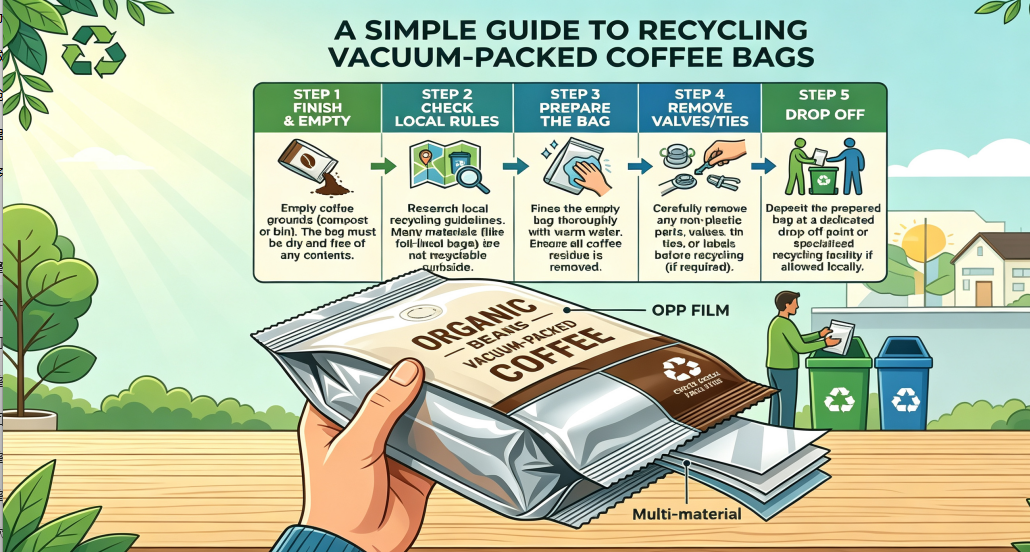
Knowing the theory is one thing. Taking action at home is another. Here's what you can do right now:
Check the label for any recycling instructions or certification symbols
Remove the valve and zipper if they're separate components, as these may need different disposal methods
Rinse the bag lightly if it has any residue—many recycling programs require clean materials
Search for drop-off programs in your area using tools like TerraCycle's website or your local council's recycling guide
Contact your coffee brand to ask whether they run a take-back or specialist recycling program
Switch to a mono-material or certified compostable bag if you're a producer looking to reduce packaging complexity
Frequently Asked Questions About Recycling Coffee Bags
Can coffee bags go in the regular recycling bin?
In most cases, no. Standard multilayer coffee bags—those combining plastic, foil, and paper—cannot be processed by typical municipal recycling facilities. They need to go to specialist programs or soft plastics drop-off points, depending on their material composition.
Are compostable coffee bags better for the environment?
Compostable coffee bags made from PLA or other bioplastics can be a good option, but only if they're composted under the right conditions. Industrial composting facilities are required for most certified compostable packaging. Home compost bins rarely reach the temperatures needed to break these materials down effectively.
How can I tell what my coffee bag is made of?
Look for recycling information printed on the bag itself. In the US, the How2Recycle label provides clear guidance. If no label is present, contact the brand directly or check their website for packaging details.
What is the most recyclable type of coffee packaging bag?
Mono-material polyethylene (PE) bags are currently the most recyclable option widely available. They can be collected through soft plastics recycling programs. However, they offer lower barrier performance than multilayer bags, which may affect shelf life.
Does removing the one-way valve help with recycling?
Yes. Removing the valve before recycling is recommended when possible, as valves are typically made from mixed materials and can contaminate the recycling stream if left attached.
Make Smarter Choices From the Start
Recycling coffee bags is possible—but it requires knowing what your bag is made of and finding the right channel for disposal. The system isn't perfect, and the burden shouldn't fall entirely on consumers. Packaging manufacturers, coffee brands, and recycling infrastructure all have a role to play in building a more circular approach to coffee packaging.
The most effective shift happens before the bag even reaches the consumer. Choosing packaging materials that are designed with end-of-life in mind—mono-material structures, certified compostable films, or bags enrolled in take-back programs—makes recycling far more achievable. For businesses sourcing custom coffee packaging, working with manufacturers like Maixin Packaging (www.maixinpackingtech.com) to specify recyclable or low-impact materials is a meaningful step toward reducing the environmental footprint of every bag sold.
Coffee packaging doesn't have to be a dead end. Understanding the connection between vacuum packed coffee technology, coffee packaging bag construction, and coffee packaging materials gives both consumers and brands the knowledge to make smarter, more sustainable decisions—one bag at a time.
TL;DR: Most coffee bags cannot go in standard recycling bins because they combine multiple materials—plastic, foil, and sometimes kraft paper—that are difficult to separate. Recycling options depend on the bag's material composition. Checking the packaging label, using specialist drop-off programs, or choosing recyclable coffee packaging bags from the start are the most effective approaches.
